
Setup and Experiments
This past Saturday, I took the dog out to the dog park and let him run around while I tried out the new antenna.
While the Jackite mast is great when there are no trees, I’ve come to prefer the throw line method of erecting antennas. It’s lighter and less bulky in the pack to carry a rope and weight than a collapsible mast.
Always looking to reduce bulk and weight, I decided to try a new throw line out. The original throw line is kinda thick and a very high viz yellow, and I wanted to get something lighter and lower profile. This line from Atwood Rope fit the bill. As you can see from the photo above, it’s made to blend into the trees. So far, I like the throw line. I was afraid with its small diameter that it might dig in to branches, but it pulled just as easily as the thicker line. This camouflage rope and the black wire are hard to spot unless you’re looking for them.
Results
In a nutshell, I can operate from 10m to 40m with a 29ft vertical wire and 17ft counterpoise. However, the length of coax changes whether or not 15m, 30m, and 40m are available.

I do know the values of inductance (L) that I’m using to achieve a match, but I can only guess as to what the capacitance (C) is — well, without doing a bunch of math. To make my settings clear, I’ve drawn arrows on my cheat sheet. To make them more intuitive here, I’m using a scale of 0 to 5, five being the max capacitance available.
| Tuner Settings for 29ft wire | 10M | 12M | 15M | 17M | 20M | 30M | 40M | 60M | 80M | 160M |
|---|---|---|---|---|---|---|---|---|---|---|
| 3ft coax | SWR=1.22 L=0.5uH C=2 | SWR=1.14 L=0.5uH C=2 | SWR=1.25 L=0.5uH C=0 | SWR=1.70 L=2uH C=0 | SWR=1.28 L=4uH C=1 | SWR=1.76 L=3uH C=5 | SWR=1.23 L=4uH C=4 | n/a | n/a | n/a |
| 25ft coax | SWR=1.5 L=1uH C=1 | SWR=1.06 L=0.5uH C=3 | SWR=1.43 L=0.5uH C=0 | SWR=1.65 L=1.5uH C=2 | SWR=1.25 L=4uH C=3 | SWR=1.66 L=3.5uH C=5 | n/a | n/a | n/a | n/a |
The bands 60m, 80m, and 160m would not tune up with less than a 3:1 SWR no matter what so I considered them unavailable.
Oddly, 40m was available with the 3ft coax but not with the 25ft coax. I could achieve a lower SWR for the other bands with the longer coax.
Also oddly, the tune on 15m with the 3ft coax was only available if I touched the BNC at the NanoVNA. As soon as I let go, the SWR shot up to 3.5 to 1. I’m thinking that I need more capacitance. I’m guessing that the 25ft coax provides a path for the radiation to go.
Given the odd results on 15m, 30m, and 40m, I’m considering adding a choke balun which adds complexity and weight, reducing the portability of this antenna.
Conclusions So Far…
I’m glad that I have an antenna for these higher bands. However, I don’t really have a portable radio for these bands, something the size of a QCX or MTR3b. I don’t like lugging around the FT-818 as it is heavy and power hungry. Boy, you can tell that I’m an ultraportable QRP nerd given that I consider the FT-818 a shack only radio! To remedy this, I’m considering building a (tr)uSDX for 10m through 20m or holding out for an update for the QMX to add these bands.
Further Questions
Now that I’ve tested the unun and tuner, I have more questions…
Will a longer wire, whether it be 35.5ft, 41ft, or the traditional 83ft, allow access to lower bands?
Is a choke balun necessary, given that different lengths of coax give me different tuner settings, even changing access to certain bands?
Will longer wires make the higher bands difficult to operate on due to odd radiation patterns?
Will a different toroid mix allow access to lower bands and retain access to 10-40m like I already have?
The first two questions will be answered in short order. I plan on experimenting with wire length first and foremost. Next, an ugly balun or some snap-on ferrite beads should allow me to achieve more predictable tuner results. As for the third question, only operating in the field with the antenna will give me the answer. The fourth question regarding other toroid mixes will only be answered once I have time to build another unun and tuner.
Next week, I’ll have more experiment results using the 35.5ft wire.
More Posts in this Series
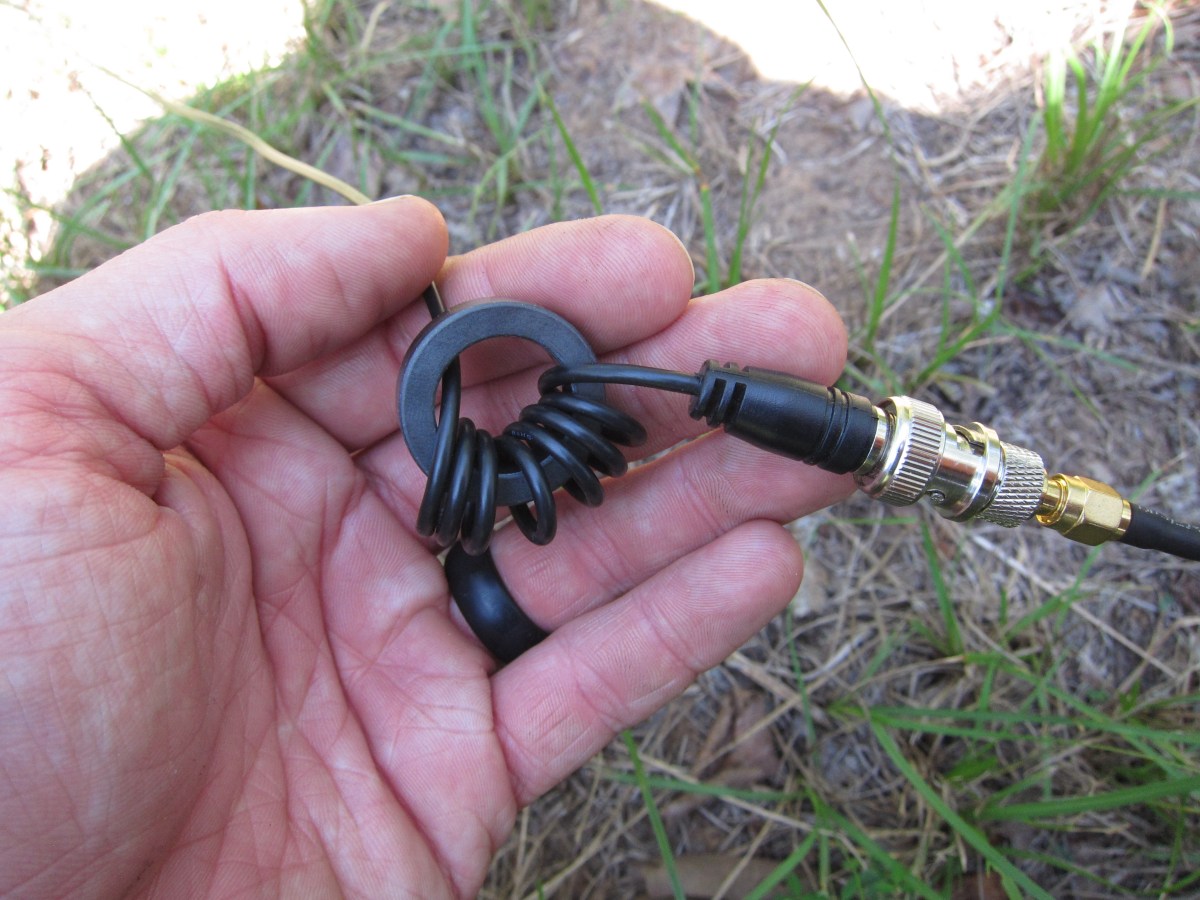
9:1 Random Wire Antenna and L-Match Tuner: Current Chokes
Current chokes help a random wire antenna greatly. But how much? So much so that they allow for operation on new bands?


9:1 Random Wire Antenna and L-Match Tuner: The Build
The random wire antenna is among the more popular options for portable operating in ham radio. Here, I scratch build the 9:1 unun and L-match tuner within a single enclosure in order to further explore which lengths of wire are best portable random wire operating.
 Amateur Radio Station WB0ISG
3 replies on “9:1 Random Wire Antenna and L-Match Tuner: 29ft Wire Experiment”
Good post. I’ve had success on 10-40m with a 29ft wire and counterpoise using just a homebrew L-match. My field ops coax is also (by coincidence) 29ft but I usually isolate it from the antenna with a common mode current choke.
LikeLike
You’ll like my upcoming post about the experiment I ran this weekend, then. It’s all about using a mix-43 toroid choke on the coax. It certainly changed my results.
LikeLike
You could maybe try the same 29ft wire without the 9:1. The L-match should be able to tune any band 40m and up without an impedance transformer. Another suggestion: an L-match can tune either a low or a high impedance wire, depending on how the capacitor is connected. It can be connected to either end of the inductor via a switch. You will find some bands are easier to match if you flick that switch.
LikeLiked by 1 person