
Since my last post in June, my family and I have moved again. This time, we have set up camp in Northeast Texas. This particular move has us renting again, which is not ideal but necessary for our current employment situation.
Long story short, I had to further downsize my ham radio kit and be content with backyard portable style operations for the foreseeable future. That’s okay. The move has caused us to reassess what we possess. As a result, I have pared my radio gear down by a good three quarters and I’m happy with my choices.
What goals did I have for my kit?
There are three things that I like in ham radio: portable operating, kit and scratch building, and antenna experimentation. My fast and light radio homebrewing setup needed to accomplish these three things.
As I have posted before, my portable operating setup became streamlined after a few failed activation attempts. Now everything I need for a POTA or SOTA expedition resides within one day pack, ready to go at a moment’s notice.
Before moving to Texas, I set my sights on only packing the truly essential to keep operating, building, and experimenting, all within the smallest footprint possible.
The Basics for Kit Building
In an attempt to take only what I needed, I decided to start off with the basics. The list below represents everything that I need on a regular basis before I set out to make anything ham radio related.
- Solder
- Soldering iron with variable temperature
- Steel wool for cleaning soldering iron tip
- Helping hands
- Desoldering pump
- Desoldering braid
- Small screwdriver
- Flush cutters
- Needle-nose pliers
- Multimeter
- Jeweler’s loupe,
- A workspace with good lighting
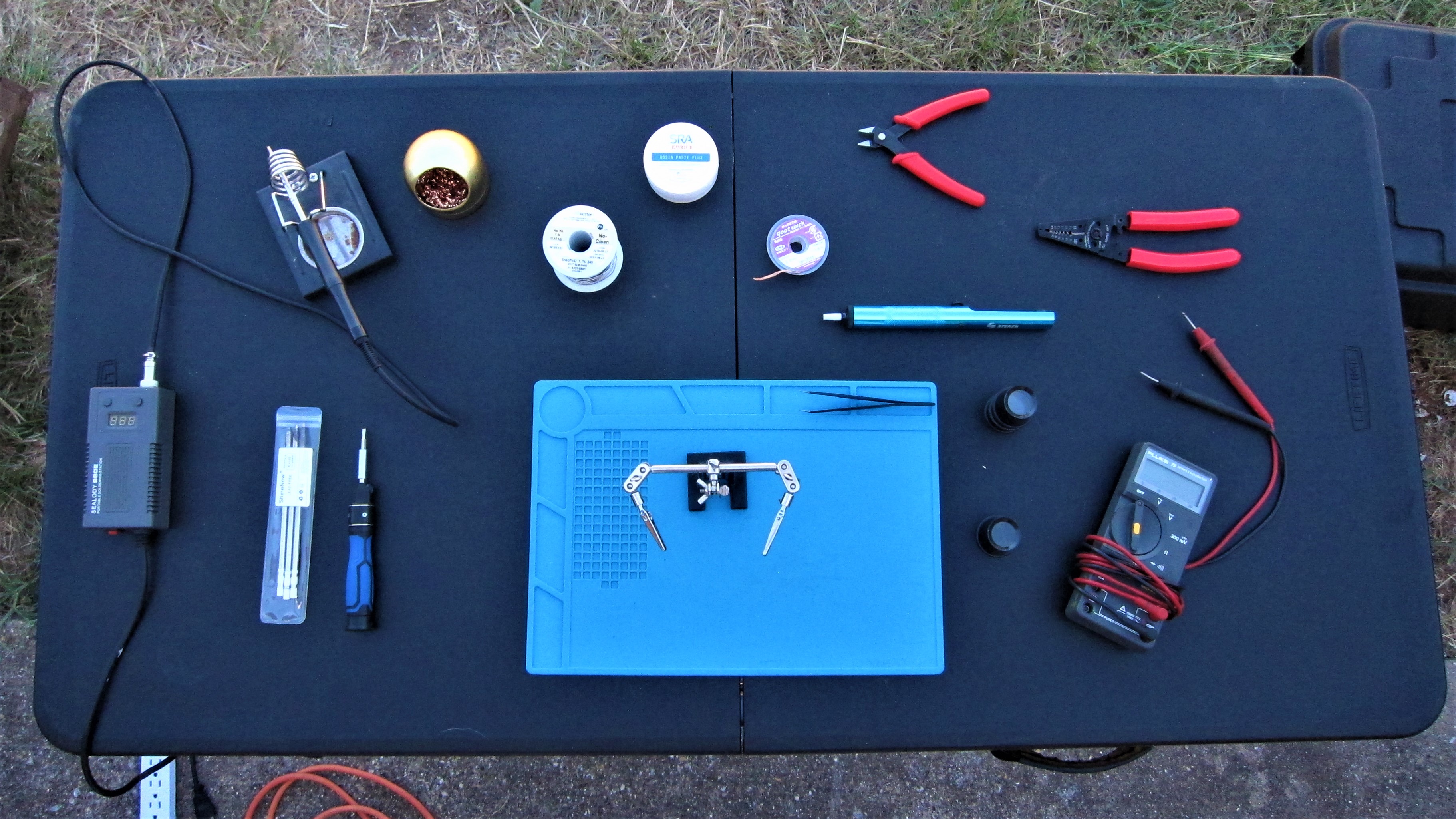
With these tools, I have built many kits successfully. The most expensive part is the soldering iron and I believe that I spent $50 on mine back in 2018. The Fluke meter was given to me by my electrician granddad.
The Antenna Building Expansion Pack
If you’re like me, kits of all varieties are fun but building the transceiver isn’t enough. Making your own antenna adds to the enjoyment. Antenna kits exist but I have recently started brief forays into scratch building antennas, including more complicated ones such as end fed half wave antennas, random wire antennas, and L-match tuners.
The list above containing kit building tools and materials are necessary to build most anything radio related. Only a bit more is needed to start making antennas from scratch.
- Wire
- Measuring tape
- BNC connectors (or whichever connector your kit radio uses)
- Various crimp-on electrical connectors (ring, bullet, spade, fork)
- Toroids
- Magnet wire
- Ferrite beads
- Variable capacitors
- High voltage capacitors
- NanoVNA antenna analyzer
- Possibly switches and knobs if making a tuner


I like to keep a few hundred feet of wire on hand. For QRP, you can get away with some small gauge stuff. I think 24 AWG strikes a nice balance between lightweight and durable.
Toroids and magnet wire are fun to play around with in order to foray into compact/multiband antennas. I recommend going with a reputable dealer, such as Kits and Parts or Palomar Engineering for things such as toroids and ferrite chokes. It is important to know that the components you are buying are what they say they are, lest the experiment not work due to shoddy material. The capacitors are nice to have on hand to make tuners or end fed antennas.
The above items I had to go buy, but the items below I’m able to find lying around the house.
- Scrap plastic or wood for feedpoints, antenna winders, etc
- String, rope, or line of some kind
- Zip ties
- Glue
- Drill and drill bits
- Hand saw
- Dremel rotary tool
With these materials, I’m able to make most antennas and even some tuners. When I need it, I can usually scrounge around for some scrap wood or plastic, rope, and the basic tools. Some might say this is cheating, but these items don’t live in the radio kit but in my tool cabinet as I use them for more often for other things.
The Transceiver Scratch Building Suite
Here is where the number of parts I had on hand tends to mushroom. For me, I wanted to be able to take pretty much any basic schematic online and have most of the components on hand to get a good start. After all, I can always get on eBay or Kits and Parts to get whatever else I may need.
Again, I have all of the components and tools listed above, plus some variety packs of discrete components.
- Resistor variety pack
- Ceramic capacitor variety pack
- Electrolytic capacitor variety pack
- Transistor variety pack
- Perforated project board variety pack
- Crystals
- Diodes
- BNC jacks, male and female
- 3.5mm jacks for headphones, keys, paddles, etc.
- Power jacks, male and female, either for 9V batteries or 12V systems (I use 2.1mm barrel jacks)
- Fuses and fuse holders
- Electronic component tester, suggested by Andy KF0ARA
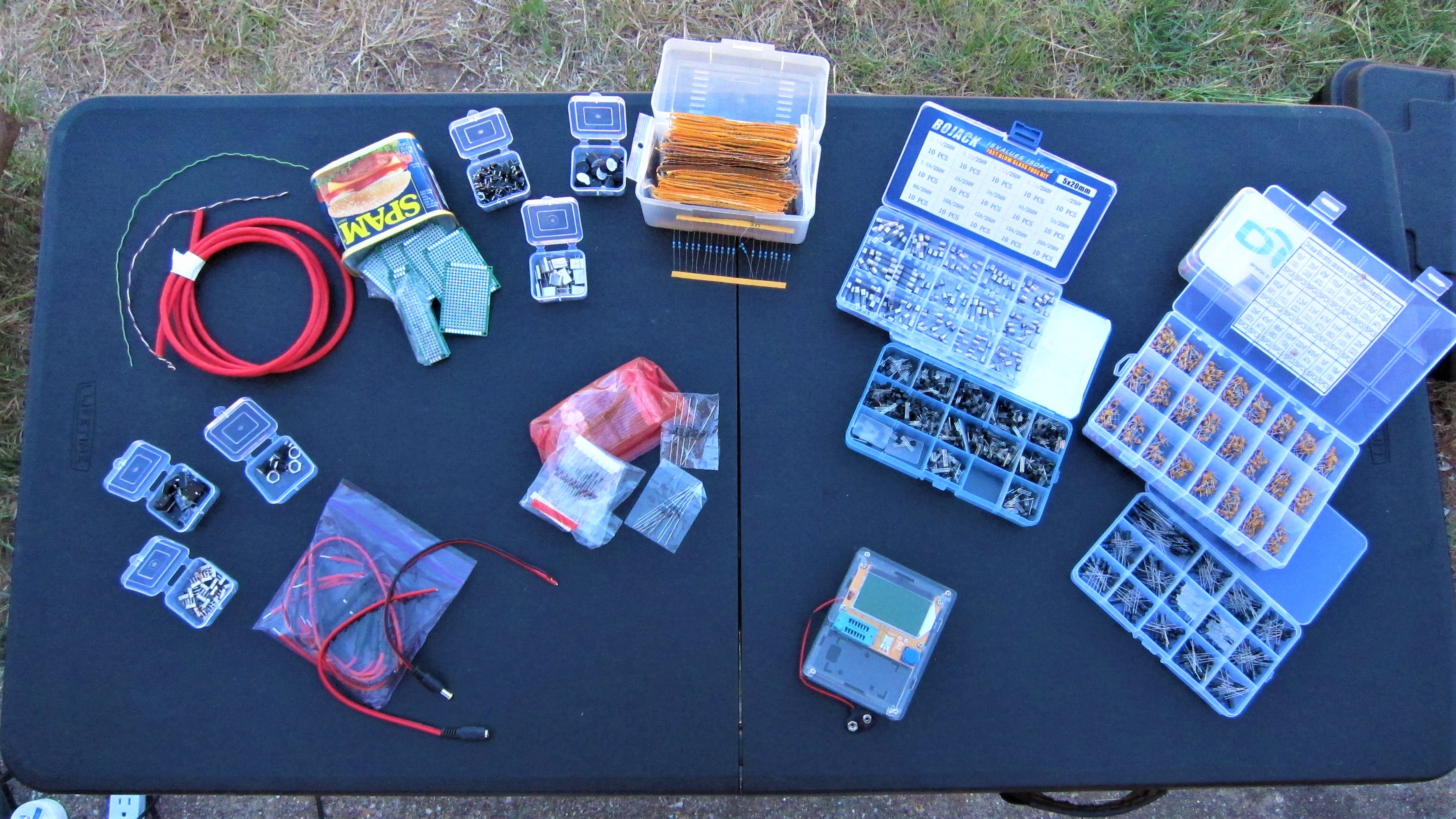
Other items I considered but ended up leaving in storage in Kansas:
- LEDs
- Potentiometers
- Battery holders
- BMS (battery management system) boards
- LM386 boards or ICs
- Speakers
- si5351 frequency synthesizer boards
- Arduinos
- MOSFETs to provide 5V, 3.3V, 9V etc.
- Some unfinished kits I have put on the back burner, or more appropriately, in the deep freeze.
I might end up regretting leaving behind some of that stuff but I can always go dig it out next time we visit my in-laws. This extra stuff, along with most of my ham radio book collection comprises an extra two boxes. As of right now, I haven’t missed anything but spare LEDs.
But as a Concept, Does the Kit Work?
Yes, really well!
On the homebrewing kit’s maiden voyage, I have built the dummy load kit by Dave, NM0S from the Four States QRP Group, a random wire antenna with a Peter, VK3YE style L-match tuner from scratch, and a scratch built basic transceiver from a schematic, the Pititico II, which is originally by Miguel, PY2OHH and modified by Ciprian, YO6DXE.

I cannot express how fun it was to see something online, decide to try it out, then create (mostly) working gear from parts that I already had on hand. I’d say the basic, portable homebrewing tool kit is a success.
Long Story Long
If the above items represent only a quarter of what I had, where did the other stuff come from and where did it go?
When I first started out, the hobby was full of unexplored avenues open to discovery and I had no idea where to begin.
I did know that I didn’t have the money for a new HF transceiver. And I also knew that I didn’t have the space for an antenna at my apartment so I eventually chose to build a portable station, SOTA style.
However, I had no electronics tools. Luckily, I had good guidance from Jim Kiefer, KD5NDJ. When I went to his shop and told him about wanting to try kit building, he said that the most important things to get were quality solder and a soldering iron with adjustable temperature. He was right; with my first good iron and some solder, I built my first transceiver and antenna kit.
As my time in the hobby grew longer, I decided to try other aspects of ham radio. I knew that I enjoyed kit building and antenna construction quite a bit. An unfortunate side effect is that my wish list for tools and materials grew. I went on a shopping spree for exotic parts that I saw other homebrewers using and for expensive bench-top power supplies and oscilloscopes. My appetite for tools and materials outstripped my electrical knowledge and so I became intimidated by the sheer number of options that I had given myself. As a result, my adventures in homebrewing and operating ground to a halt.
While moving is rarely enjoyable, I did come to appreciate the peace and satisfaction of rediscovering which items I own are truly important to me.
I’ve since sold two transceivers that I almost never used and also sold my oscilloscope.
I also made a donate pile of all the electrical components that I had too many of. Eighteen of my twenty four 9V battery clips (and other similar duplicates) found a new home at the local library’s makerspace.
Most importantly, I gave away my copies of QST, On the Air, and QRP Quarterly, along with my HF boat anchor, the Kenwood TS-520, to my electrical trade apprenticeship instructor and his son who had expressed interest in the hobby. During class, he was teaching me and my classmates the theories behind all those Extra class questions I had memorized all the answers to so long ago. I have a feeling that he and his son will enjoy the rig more than I was. Once licensed, of course.
The Future is Now
Nowadays, I build my gear outside for two reasons. First, we now live in a two bedroom apartment. Space is at a premium. Second, there’s nowhere inside that I can permanently cordon off from a two year old while I mess around with electronics. I don’t dare leave any surface within his reach where there’s any risk of him getting into lead.
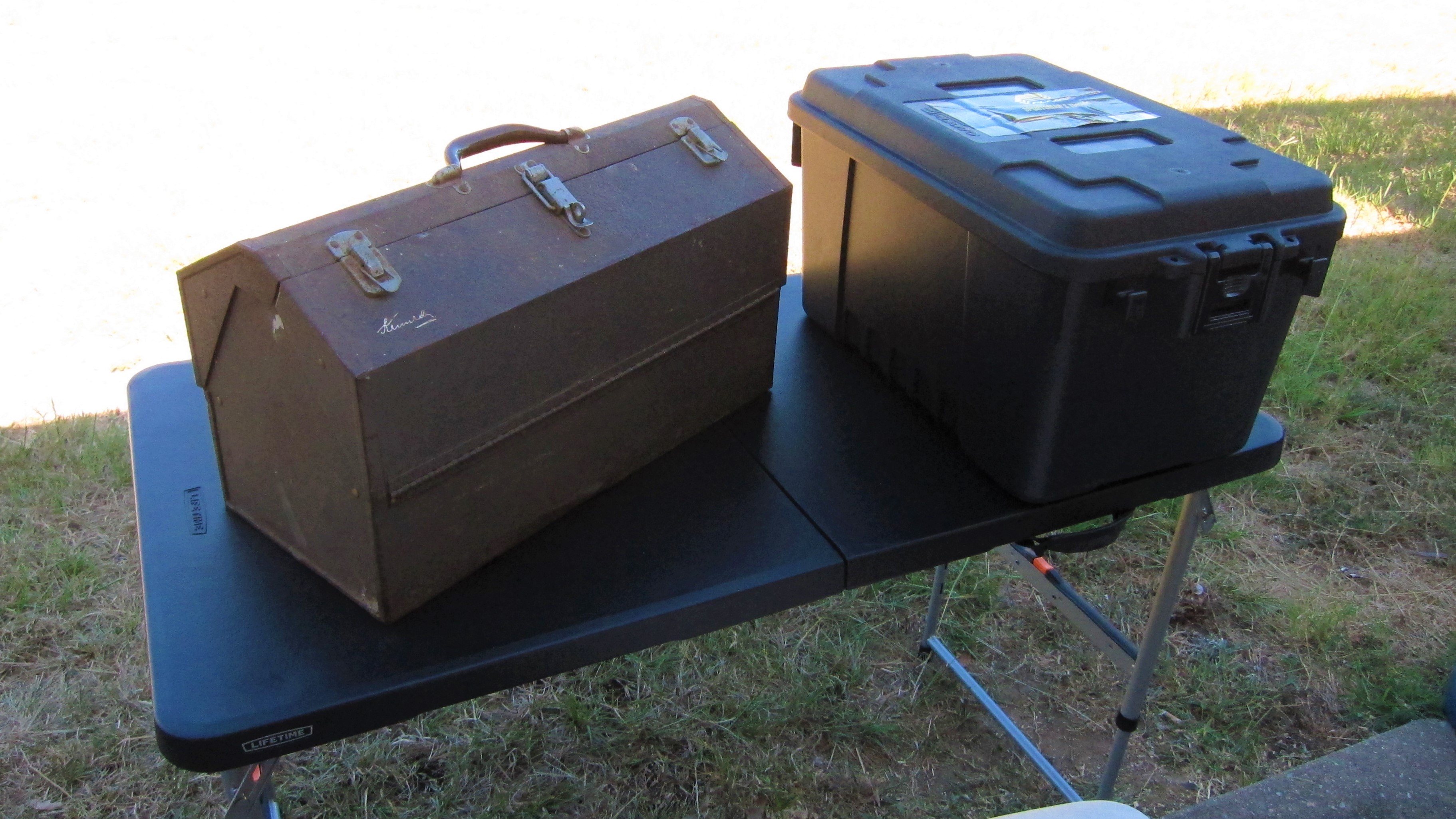
While somewhat inconvenient, building electronics does have advantages. I have to plan ahead, which causes me to look forward to opportunities to play with radios. Nor am I able to leave a project out indefinitely. As a result, I have completed more projects here lately. The portable workshop really comes into its own given that everything must be packed out and then back inside to live within one tool box and one foot locker.
I’ve also operated more lately because I’ve had to figure out which hours maximize my time on the air. I’ve enjoyed figuring out when QRP events are taking place and have taken advantage of the challenge of setting up a station, trying to get into a net or event, then packing it all back up in the twilight.
Now that my station is this way, I appreciate that there’s nothing extra, that it is streamlined, that everything has a place and a purpose. Paradoxically, the constraints are liberating. This new way of operating and experimenting has restored a sense of joy and playfulness to this hobby which had grown stale for me.


 Amateur Radio Station WB0ISG